Drywall repair in New City, built up one coat at a time
Stained ceilings under an upstairs bathroom, seams that split open every January, and scuffed, dented walls on the lower floor of a raised ranch: this is the work New City Drywall Repair does around this Clarkstown hamlet. Tell us what you are looking at, and we will talk through the cause, the compound we would reach for and how many visits it takes to dry and finish properly.
Ceiling water stains
A brown ring under a tub or a winter roof leak, sealed so it never ghosts through the paint again.
How stained ceilings get fixedCracks that keep returning
Cut out, re-taped in setting-type compound and feathered wide enough to ride out the next heating season.
Why some cracks come backLower-level patches
Dents and damp edges on the half-below-grade floor, patched with board that tolerates a basement.
Patching a raised-ranch lower floor
Read an older wall before cutting
New City stayed mostly fields and woods until the 1950s. The Tappan Zee Bridge and the Palisades Interstate Parkway then put Manhattan within a commute, and the Town of Clarkstown went from 15,674 residents in 1950 to 61,653 by 1970. A large share of the houses we open up date from that rush: split-levels, raised ranches and center-hall colonials, framed quickly and finished with the board and joint compound of the day.
That history changes how a repair starts. The oldest houses on the hamlet's wooded roads can still have plaster over wood lath or over gypsum lath, and plaster wants a bonding agent and a bit of patience rather than a square of new board pressed into a hole. Early drywall is sometimes thinner than the half-inch sheets sold now, so a patch piece may need a shim behind it to sit flush with the old face. We test with a utility knife in an out-of-sight spot before deciding.
Paint is the other thing we look at. Older layers in a house this age can contain lead, so on those walls we keep dry sanding to a minimum, mist the dust down, wet-wipe as we go and tape plastic around the work. Settling cracks over doors and windows are common in these homes too; most are cosmetic, and the trick is to rebuild the joint so it can flex instead of just filling it.
Pick what you are seeing
Tap the closest match. The estimate form opens with that problem already chosen, so all that is left is your name, number and a sentence or two.
Match each symptom to a cause
- Thin crack running up from the corner of a door or window
- Framing movement collects at the header, and the joint there was taped with too little compound behind it. See re-taping a cracked joint.
- Crack where the ceiling meets an outside wall, wider in winter
- Roof trusses or joists lift slightly as the attic dries out in cold weather, then settle back in summer. See ceiling seam fixes.
- Small round bumps in a straight line
- Nail pops: fasteners backing out as the studs behind them shrank and twisted. See screw-and-patch work.
- Bubbled or blistered tape along a seam
- Paper tape bedded with too little compound under it, or a joint that took on moisture. See tape replacement.
- Tea-colored ring or halo overhead
- Water from a tub, toilet seal, radiator line or roof flashing has wet the board and left minerals behind. See water-stain sealing.
- Ceiling board bowing downward
- Soaked gypsum has lost its strength or the fasteners have let go. Keep people out from under it. See soft and sagging ceilings.
- Crumbling bottom edge of a lower-level wall
- The board is wicking moisture from the slab or a past flood. See lower-level wall patching.
Browse the four repair services
Every repair below is plain drywall and plaster work. We do not sell or install anything else, which is why we get to be fussy about compound and tape.
Ceiling Water Stain Repair
Rings and soft spots under a bathroom or a winter roof leak, sealed or cut out and rebuilt flat.
Wall and Ceiling Crack Repair
Seams and door-corner cracks that reopen every heating season, rebuilt with tape bedded in setting-type compound.
Basement Drywall Patching
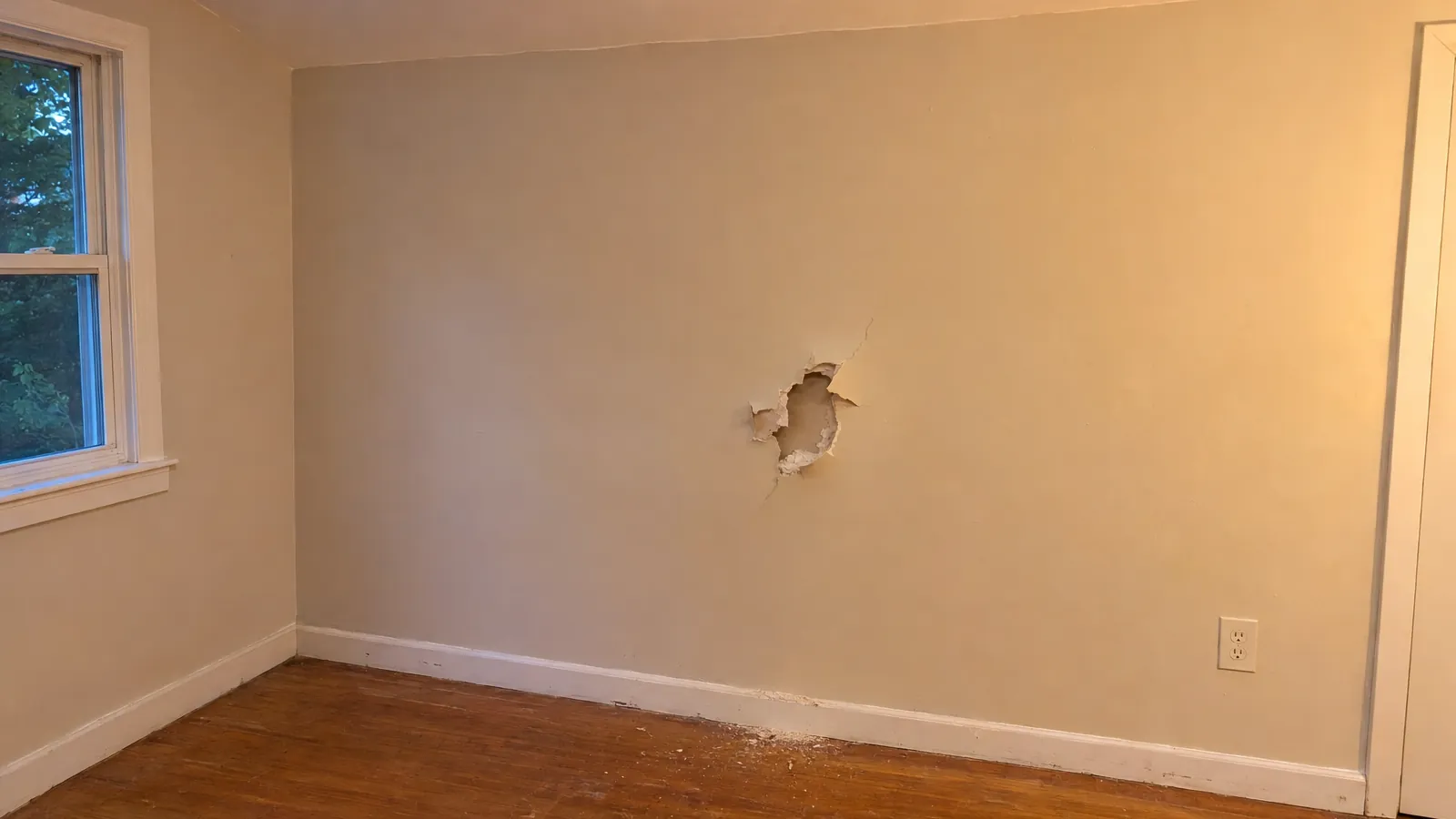
Gouges, dents and damp bottom edges on the half-below-grade floor of a raised ranch or split-level.
Drywall Hole Patching
Doorknob punch-throughs, anchor holes and old TV-mount scars, backed, taped and feathered out of sight.
Collect these details beforehand
- Two photos. One straight on, one from the side with a lamp or flashlight raking across the wall. Low-angle light shows how far a crack or bulge really runs.
- A measurement. Run a tape across the widest part of the hole or stain. Put a light-switch plate or a dollar bill in a photo if you can.
- The water shut off. If anything is still dripping, close the stop valve under the fixture above or the main, and switch off any light near the wet spot.
- A pencil line. Trace the edge of a fresh stain. If it has crept past the line by tomorrow, the leak is still active.
- The surface. Note whether the wall is smooth or carries orange peel, knockdown or a popcorn ceiling.
- The paint. The color name or the lid of the leftover can saves a trip to the paint counter.
Factor in where the house sits
South Mountain Road
One of the hamlet's quiet, wooded, older neighborhoods. Houses here are more likely to predate the subdivisions, so plaster walls and mixed materials from later additions are both on the table.
Lake Lucille
Another wooded, long-settled pocket. Expect a mix of original rooms and remodeled ones; one wall may be plaster and the one beside it a later sheet of drywall, and each gets patched its own way.
The postwar streets
The 1950s through the 1970s left New City with plenty of split-levels and raised ranches. Their stairwell walls, half-flight landings and bathrooms stacked over living rooms are where our ladders spend most of their time.
Weigh what makes a job grow
We quote each job after seeing it, and the same few things decide whether it is a short visit or a longer one.
- Size. A screw hole fills in one sitting. A doorknob hole needs a backed patch and three coats. Past a couple of feet across, cutting back to studs and hanging a new piece is usually faster than patching.
- Ceiling or wall. Ceilings mean ladders or planks, plastic over the furniture and slower knife work overhead.
- Reach. Two-story stairwell walls and the space over a tub take extra setup before the first coat goes on.
- Texture. A smooth wall only needs feathering. Knockdown, orange peel or popcorn has to be rebuilt and tested on scrap before it touches the wall.
- Moisture. Wet board has to dry out, and the leak has to be fixed, before anything goes back up.
- Paint. A patch painted on its own can flash. Often the cleanest result is painting the wall corner to corner.
Check the towns around the hamlet
Most of our days are spent in New City itself, but the same drywall problems show up all over this side of Rockland County.
- Congers sits east of New City across Lake DeForest, reached over the Congers Road causeway.
- Bardonia and Nanuet lie just to the south, both Clarkstown hamlets.
- Valley Cottage and West Nyack are Clarkstown hamlets a short drive away, one near Rockland Lake and the other along Route 59.
- Spring Valley, Pomona and Stony Point take a little more driving, and we still go.
Ready the walls before listing
Listing photos and move-out walkthroughs are hard on drywall because the camera and the inspector both look at walls in flat, even light. The repairs that matter most are the ones a buyer notices from the doorway: a doorknob hole behind a bedroom door, anchor holes where shelving came down, a stain on the kitchen ceiling under the hall bath, and the crack over the front-hall closet.
Leave the small stuff that a coat of paint will hide anyway. Picture-hanging nail holes can be spot-filled with lightweight spackle and a putty knife the night before the painters come. What does not belong on that list is any stain you have not traced to its source; a buyer's inspector will ask about it, and a sealed-over ring with an active leak behind it only resurfaces at the worst moment.
Schedule us before the painters, not after. Setting-type compound hardens on its own clock, but the topping coats still need a day to dry between passes, and the primer needs to cure before finish paint goes on. Give the drywall work three to four days ahead of the paint date and the painters can roll straight over it.
Look closely at the ceiling
Ceilings take more of our time than walls. Gravity works against every patch, and a flat ceiling lit by a window shows every ridge in a seam.
Stains and soft spots
In a split-level, the upstairs bathroom often sits over the kitchen or living room. A tired wax ring or a cracked tub drain soaks the board slowly, and a ring appears long before anything drips. Firm, dry stains just need a coat of shellac-based primer to lock them in; soft board gets cut out.
Cracks along the top of an outside wall
A gap that opens between ceiling and wall in winter and closes in summer is usually the roof framing lifting as the attic dries. Taping it tighter only tears it again. We use a flexible approach there, and sometimes a trim piece is the honest answer.
Popcorn and other textures
Plenty of ceilings from the postwar decades carry a sprayed acoustic finish. Before we scrape or patch one, we ask that it be tested for asbestos, then rebuild the texture on a scrap of board until it matches. Our drywall guides walk through each common ceiling finish.
Expect some movement in newer framing
Not every house here is old. Where a lot was rebuilt or a house was gutted to the studs, the first couple of heating seasons bring their own set of small problems. Fresh framing lumber dries out and shrinks, so screws that were snug at hanging time stand proud and push a little circle of compound off the wall. Long hallways show hairline lines at butt joints, and ceilings under an attic can open at the corner when trusses lift in cold weather.
None of this means the house was built badly. It means the framing is settling into the moisture level of a heated home. The repair is to drive a new screw beside each popped one, set the old one deeper, and coat the spot with lightweight compound. For truss-related corner cracks we skip the rigid tape and use a joint that can move.
Send us a look at the wall
Call during our hours, send a snapshot by text, or use the estimate form. Tell us the room, roughly how big the damage is and whether it is still wet, and we will come back with what the repair involves and when we can start. If you would like to know how a visit runs first, here is how we work a job.